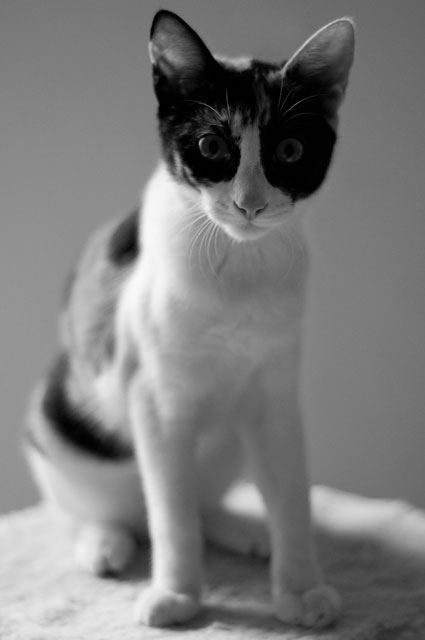
Cats have numerous means of communication. The main ones are:
Verbal language
Purring
This comes from rapid contractions of the muscles of the larynx and diaphragm, appearing from the first week of age.
Cats purr in the presence of another cat or a person. It is an expression of joy or submission.
Meowing
There is a wide variety of meows, each with its own meaning:
- demand, defeat, lament, growl and snort (used to defend themselves in case of aggression) and rejection.
Body language
Cats also communicate through their tails, heads, ears and eyes. For example, a cat that is alert will keep its tail upright and its ears pricked up. A straight tail is a sign of well-being. Other examples:
- Stretched body, head held high, smooth fur, tail upright, ears forward, eyes wide open, whiskers together, purring and meowing: friendly behaviour.
- Body stretched out, smooth fur, tail wagging, ears forward, eyes round, large and open, whiskers spread forward: crouching behaviour.
- Body arched over legs, hair bristled on back and tail, tail wagging and curved, ears back, pupils retracted, whiskers spread apart, hissing and squealing: stalking behaviour.
- Body with curved back, bristled hair, tail wagging in all directions, ears on sides, dilated pupils, straight whiskers, piercing squeals: angry behaviour.
- Body folded over hind legs, hair lying flat, tail shaking, ears back, dilated pupils, whiskers back, snorting: defensive behaviour.
Smells
Urine marks, secretions from the anal glands and parietal glands (under the cheeks) are used by cats to communicate with each other and with other species.